
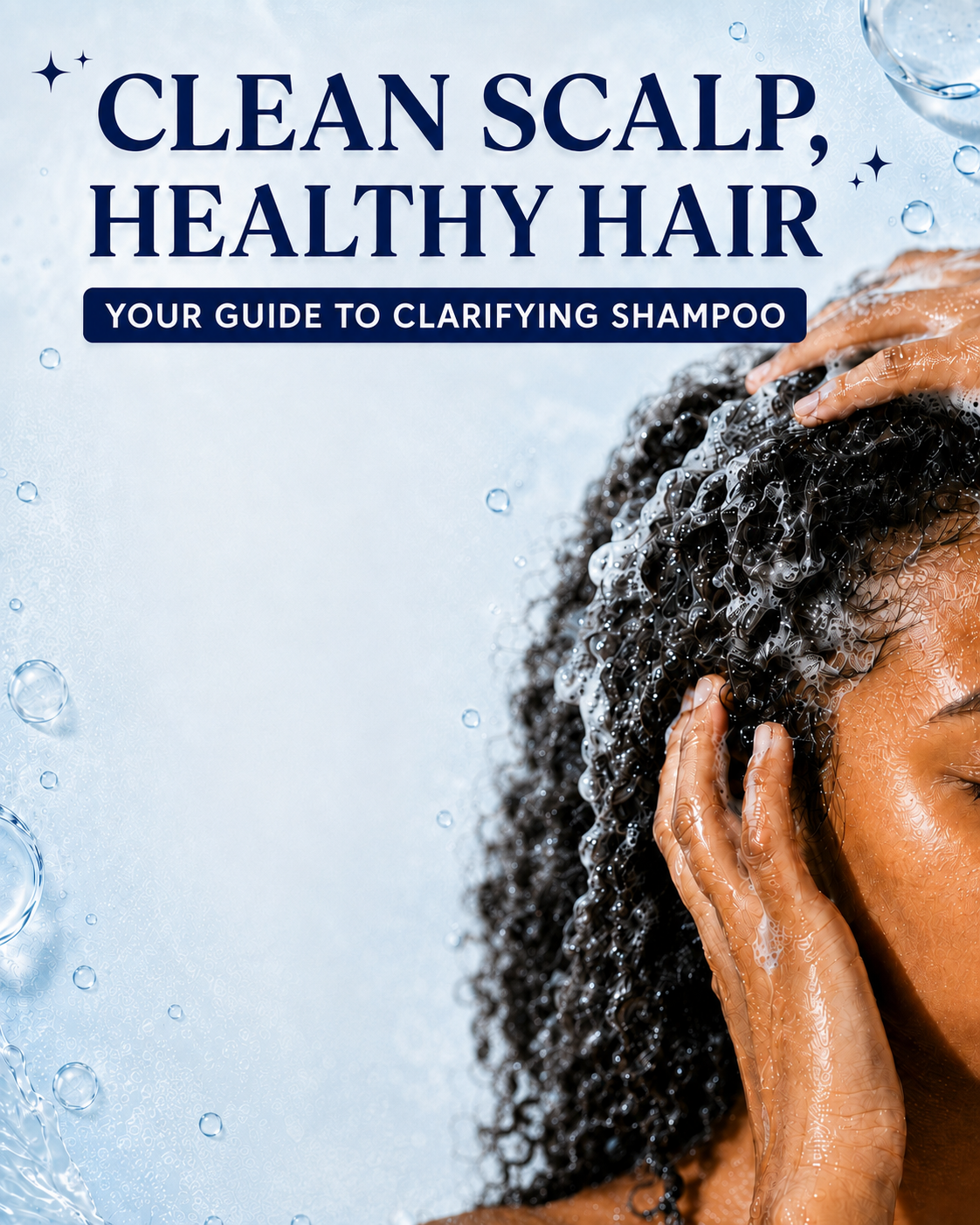
One of the most important things when starting a healthy hair journey is making sure your scalp is clean. Our hair grows from the scalp, so it makes sense to start with a clean base. And when your regular shampoo isn’t quite cutting it, that’s where clarifying comes in. In this first haircare post, we’ll go over all you need to know about clarifying shampoos.
What is a clarifying shampoo? How do I know if I need one?
Clarifying shampoos are designed to deeply cleanse your hair and remove buildup, think of them as hitting the reset button on your hair and scalp. They’re pretty stripping and skip the conditioning agents you’ll find in other shampoos, which is exactly what lets them cut through everything that’s been piling up on your strands.
Your hair will usually tell you when it’s time to clarify. The classic sign is hair that feels heavy, limp, or flat no matter how you style it — almost like it’s weighed down by something invisible. You might also notice that your hair looks dull or cloudy instead of shiny (buildup literally blocks the light from bouncing off your strands), or that your favorite products suddenly stop working; your leave-in just sits on top, your curls won’t clump, your styles fall flat by lunchtime. Another sneaky one: roots that get greasy within hours of washing, or a strand that feels almost waxy or coated when you run your fingers down it. And don’t ignore your scalp! Persistent itchiness or flaking that regular shampoo isn’t fixing can be buildup, too. A few lifestyle clues to reach for one: if you use a lot of dry shampoo, gels, or oils, swim in chlorinated pools, or live somewhere with hard water (hello, brassy tint and that squeaky-but-never-clean feeling), you’re a prime candidate.
Just keep in mind that persistent itching or flaking isn’t always buildup — if clarifying doesn’t help or your scalp is red, irritated, painful, or persistently flaky, you may be dealing with a scalp condition rather than dirty hair. If that’s the case, it may be time to book an appointment with your dermatologist to figure out what the cause might be.
How often should I use it?
Because they’re so stripping, clarifiers aren’t meant for every wash. I choose to use a clarifying shampoo 1-2 times per month — more often in the summer months since I sweat more and enjoy going to the pool and the beach. This routine works well for my hair, but it may take a little trial and error to find your own rhythm.
What ingredients should I look for?
Surfactants
There are a few ingredients to keep in mind, and the first is a surfactant. Surfactants are compounds that lower the surface tension between two things that don’t usually mix (think oil and water), which is exactly how they lift grease and buildup off your hair. The two main workhorses are Sodium Lauryl Sulfate (SLS) and Sodium Laureth Sulfate (SLES).
When I first started researching clarifying shampoos, I was a little shook to learn that SLS and SLES also show up in Dawn dish soap — how could I possibly put that on my hair?! But that cleansing strength is exactly the point, and it’s usually softened by pairing it with Cocamidopropyl Betaine, a coconut-derived co-surfactant that takes some of the harsh edge off SLS and SLES.
If you’re someone that would rather skip sulfates altogether, some clarifiers swap in cleansers like sodium C14-16 olefin sulfonate or plant-based glucosides. It’s important to note that a “sulfate-free” label doesn’t always mean gentle.
Additional key ingredients
First up, citric acid (an alpha hydroxy acid) is added to keep shampoo in a similar pH range to your scalp (around a pH of 5.5). You may also spot a chelating agent like Tetrasodium EDTA or Disodium EDTA. These ingredients bind metal ions, which can help stabilize the formula and, depending on the formulation, help address mineral buildup (more on that in another post). And the last one you’ll see is sodium chloride, plain ol’ table salt usually added to thicken the formula.
One last thing worth knowing: part of what makes a clarifying shampoo “clarifying” is what it leaves out. Many everyday shampoos include conditioning agents designed to leave the hair softer and more manageable. Clarifying formulas generally prioritize cleansing over deposition, which is part of why your hair can feel so squeaky-clean afterward.
What do I do after I clarify?
After using a clarifying shampoo, many people choose to follow up with a hydrating/moisturizing shampoo before continuing on with the rest of their routine. I choose to go straight in with my regular deep conditioner instead. Since clarifying can leave my hair feeling a little stripped, I like following it immediately with something moisturizing rather than adding another shampoo step.
A quick note on who should go easy
Clarifying is amazing, but it’s a bit of a heavy hitter and that strength isn’t for everyone, every time. If your hair is color-treated like mine, clarifying too often can fade your color faster (all that deep-cleaning doesn’t discriminate). And if your hair runs dry, damaged, or is curly or coily (which tends to be thirstier by nature) a strong clarifier can leave it feeling stripped and straw-like if you overdo it. None of this means clarifying shampoos are off-limits for you; it just means you may need to reach for one a little less often, and always follow up with a good conditioner or deep-conditioning treatment to put the moisture back. As always, listen to your hair. If it feels crunchy and sad after, you’ve clarified too much.
The Monday’s Edit
Clarifying shampoo is your reset wash. Reach for one when your hair feels coated, heavy, unusually greasy, dull, or like your usual products have suddenly stopped working. Look for an effective surfactant system, remember that sulfate-free doesn’t automatically mean gentle, and always follow a deep cleanse with plenty of conditioning.

Sources: On Hair Care Physicochemistry: From Structure and Degradation to Novel Biobased Conditioning Agents, Shampoo and Conditioners: What a Dermatologist Should Know?, The Shampoo pH can Affect the Hair: Myth or Reality?
Did you learn something new from this deep dive? How often do you clarify your hair? Let me know down below!
With love,
Ash ♡
Leave a Reply